Deconstructing the Classical with Joy Bonfield-Colombara
There are artists who work in the present but carry the past in their hands, reshaping it into something entirely new.Joy Bonfield-Colombara, known as Joy BC, is a London-born goldsmith and artist whose artistic practice brings together sculpture, hand-carving, metallurgy, and symbolic storytelling. Her work has been exhibited internationally, including at Salon Art + Design in New York, and is held in museum collections across Europe and the United States.
On Friday, November 7th, The Fifth Avenue Hotel hosted our dinner series, Overheard at The Fifth, in Joy’s honor. Eighteen guests gathered to hear her reflect on the artistry, inspiration, process, and craftsmanship that guide her practice. The evening offered a rare glimpse into the ideas that shape her creative world and the sensibilities that define her approach.
Reimagining the Classical
Joy’s connection to antiquity began early. She recalled being drawn to classical forms across cultures, explaining, “Since I was a child, I have been attracted to ancient and classical art from across the continents: from the Greek victory of Samothrace to Roman sculptures of Venus, Egyptian carvings of Nefertiti, Benin Bronze portraits, and Japanese Urushi objects. I am simultaneously an old soul and a young heart.”
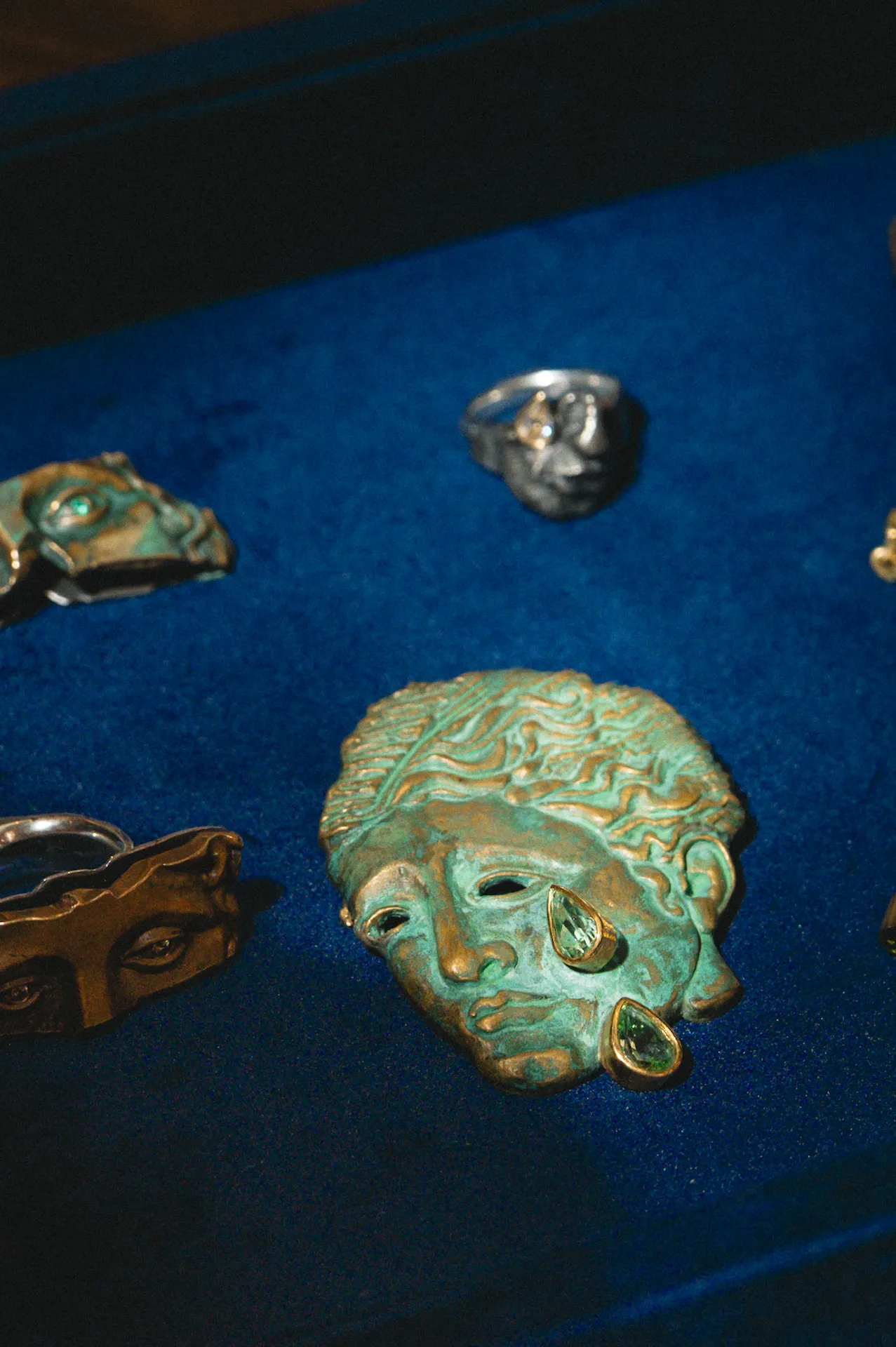
Her work is, in her words, “an ode to, and a deconstruction of, classical representations of femininity and beauty.” She gravitates toward natural materials and studies the stories that have echoed across millennia, approaching ancient markers of identity through a process she describes as “deconstruction and reconstruction.” Her aim is not to reproduce but to reimagine. As she shared, “Being playful and gently provocative around forms that we just accept without questioning is part of my creative process.”
This approach often creates the sensation of encountering something both familiar and new. Joy finds meaning in those moments when someone feels “they recognise something in it, but at the same time have never seen anything like it, and especially not in the form of jewelry.” In this way, her reinterpretations unsettle assumptions and invite reflection on inherited ideals.
Craft and the Discipline of Time
A major chapter in Joy’s development unfolded in Kyoto, where she studied urushi, the ancient Japanese art of natural lacquer, through a research fellowship awarded by The Royal College of Art. Urushi has been used for thousands of years to coat ceremonial vessels, sacred objects, carved boxes, and everyday tools. The material is drawn from the sap of a tree and requires extraordinary patience, precision, and care.
During her time in the studio, Joy worked within an environment designed specifically for this kind of craft. She described it as a place defined by stillness and intention, recalling how “There is even a specific room, which is mandatorily silent, where no dust moves in the air, to apply the layers. It can take months and months to build up the lacquer.”
The experience shifted her understanding of craftsmanship itself. She came to see time as a material, sharing that “To take time on a work is the most precious material of all.” It also broadened the spirit of her practice, which she describes as oscillating “between the decorative arts, deeply emotive narrative, conceptual and philosophical practice, and there is a good measure of science along with magic and alchemy too.”
Meaning, Myth, and the Inner Life of Objects
Joy often describes her pieces as objects that “venerate philosophies or ideas that are important, poetic, and often shifting perspectives on value systems.” Much of her work begins with a question or a feeling she wants to understand more deeply, and two examples show how she brings these ideas into physical form.
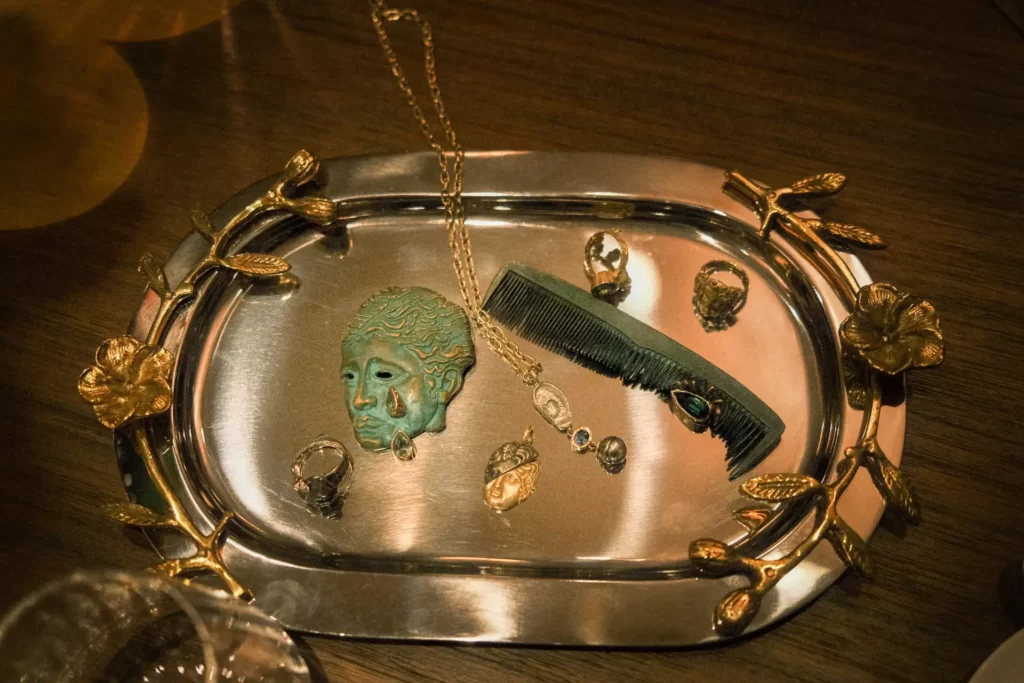
One of her longest-running explorations is focused on tears. She has spent more than ten years studying them across different cultures and within science. Joy shared, “Tears contain huge creative power. They are sprinkled on the ground to call the spirits. They are used in potions to heal wounds. They are even thrown in front of robbers to create floods.” By transforming something ephemeral and delicate into a gemstone, she hopes to “shift [the idea] that tears in the west are sometimes seen as a weakness or negative,” instead celebrating “the strength it takes to show one’s vulnerability.”
Another example is her piece, Listening Aid, a sculpted ear that acts as a small reminder to be present. Joy created it after noticing her own tendency to think ahead rather than fully listen. As she explained, “Active listening is about suspending one’s inner dialogue to listen to others. I can talk a lot and wanted to be conscious of listening better.”
Wearable Art and Miniature Sculpture
Joy’s work is shaped through instinct, touch, and years of muscle memory. She has shared that “God is in the detail,” which guides how she approaches form and material. She often follows the shape with her hands, feeling her way through decisions that give each piece its presence. Some works expand beyond what many might consider traditional jewellery, yet remain human in scale. That physical balance creates a sense of intimacy even when a piece carries the presence of something sculptural.
Meaning is central to her practice. Joy explained that “Some of my works I think are described as sculpture and wearable art, because it is not merely decoration. There is always a story, a deeper, layered meaning to the work.” She also returns often to the idea that “For me, a jewel is truly beautiful in how it feels, not only how it looks.” Her pieces hold narrative, sensation, and presence all at once.
A Shared Way of Seeing
Joy’s work lives in the space between history and reinterpretation. Her pieces invite slow attention, encouraging those who encounter them to notice the surfaces, shapes, and stories that emerge through touch and time. That commitment to presence, and to the emotional life of objects, is central to her artistic voice.
This sensibility resonates with The Fifth. Here, we bring together history, imagination, and craftsmanship through the hotel’s architecture and atmosphere, creating a setting where detail has meaning and heritage informs experience. Joy’s practice aligns with that spirit. Both her work and The Fifth honor tradition while speaking in a modern language, inviting people to see the familiar in a new light.